
What Upshur Tax Records Show
MapWV serves as the public source for Upshur assessment fields. A single parcel result can break out land, building, and total appraisal. It also shows the owner of record, mailing and situs address, class, land use, acreage, and deed reference. Sale history and the legal description appear when available. A tax bill answers a different question. It shows what was billed, paid, or left unpaid. Upshur County publishes no live bill-search page. Confirm collection access with the sheriff or tax office rather than treating the assessment search as a payment ledger.
| Field | What It Shows | Where |
|---|---|---|
| Appraised / true value | Assessor's estimate of the property's full value | MapWV assessment result |
| Assessed value | Tax assessment generally set at 60 percent of current appraised value | Assessor roll |
| Owner and parcel | Owner, mailing/situs, district, map, parcel, and legal description | MapWV |
| Exemption indicator | Any exemption field shown on the assessment result; local details need confirmation | Assessor |
| Bill and delinquency | Amount due, payment, sale, or redemption status | Sheriff / tax office or State Auditor |
Assessed value is the base for the tax calculation, not the bill itself. The tax year and applicable levy set the final amount. Sale price is a different fact. Match it against the recorded deed. Keep each figure in its own column when comparing a parcel across records.
West Virginia's Sixty Percent Rule
West Virginia Code §§11-3-1 and 11-1C-12 call for uniform assessment at 60 percent of the most current appraised value. The statutes set 60 percent as the fraction of true-and-actual value used. That statewide rule explains the gap. An assessed figure can sit well below full value. It does not shrink the bill to 60 percent of a property's price. Levies and other billing factors still drive what is owed. MapWV separates land, building, and total appraisal fields. It may also show sale data or tax classification. Record the year and value label exactly. Wondering what a parcel would sell for? The county assessment is a comparison starting point, not an appraisal prepared for a transaction.
Finding an Upshur Tax Bill
Start from the assessed parcel, but never assume the MapWV result reports what was actually paid. Upshur County publishes no public bill-search page. Call the sheriff or tax office instead. Ask which payment channel or annual delinquent-land publication covers the tax year in question. The State Auditor may hold delinquent-land records too. Have the full parcel ID, tax year, and owner of record ready so staff can tell nearby tracts apart.
- Use MapWV to confirm the district, parcel, owner, and legal description.
- Ask the sheriff or tax office which channel supplies the bill and payment history for the year.
- Check whether an exemption is shown on the roll and ask the Assessor about its local status.
- If delinquent, confirm the sale, redemption, and tax-lien record with the responsible office.
- Assessed value
- The tax-assessment figure, generally 60 percent of current appraised value in West Virginia.
- Levy
- The local tax rate applied to taxable value; confirm the current county schedule.
- Exemption
- A statutory reduction or treatment recorded on a roll; do not assume eligibility from a field label.
- Tax lien
- A claim tied to unpaid property tax, with status confirmed by the official tax record.
Upshur Assessment Search Fields
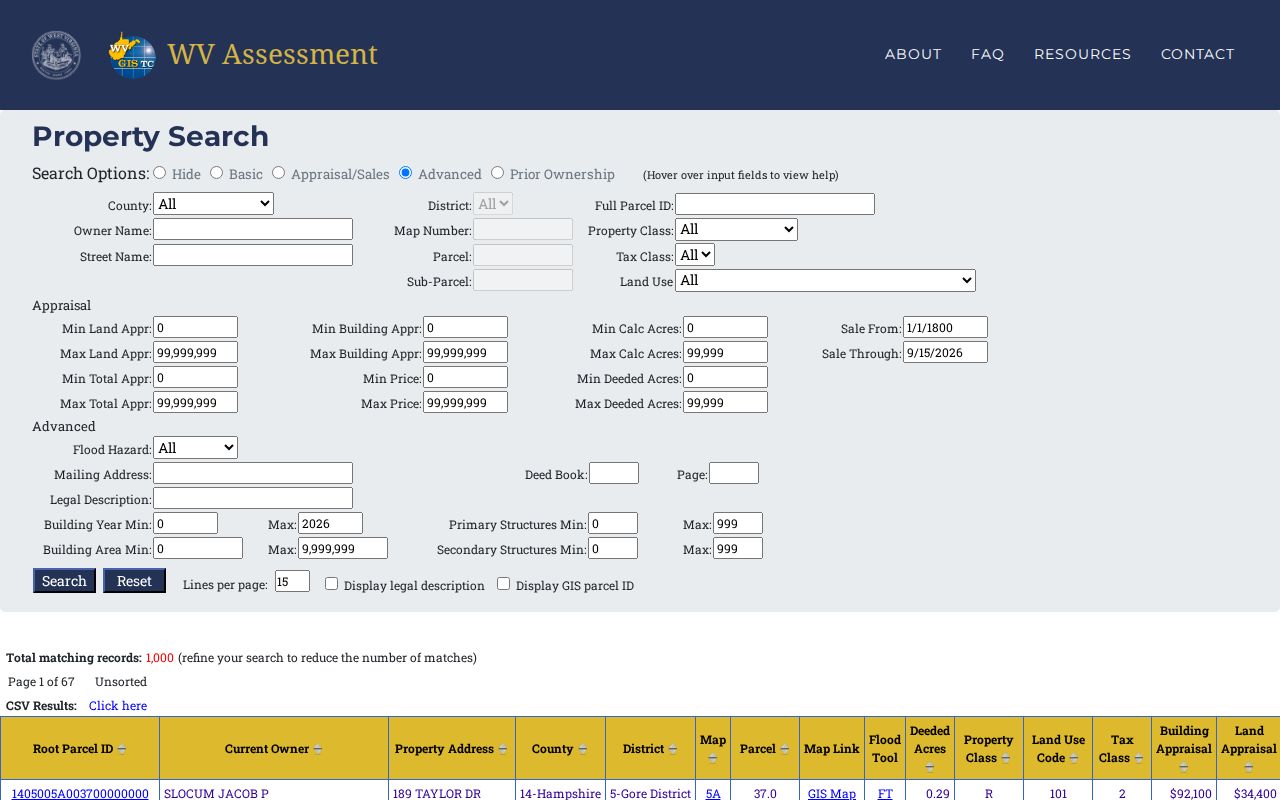
The MapWV search does more than find a parcel. County and district selectors define the tax geography. The full parcel ID, map number, parcel, and sub-parcel pinpoint the record. Owner and street name work as broad entry keys. Appraisal ranges and acreage filters help when the legal description is only partly known. Sale date and price controls can isolate history that needs a deed check.
| Portal control | What it filters | Follow-up |
|---|---|---|
| County and district | Assessment jurisdiction | Save the district code with the parcel |
| Owner, street, mailing | Name and address matches | Compare mailing with physical situs |
| Map, parcel, sub-parcel | Parcel identity | Use all displayed pieces unchanged |
| Land/building/total appraisal | Value range | Note the year and value type |
| Sale dates and price | Assessment sale history | Confirm consideration in the deed |
The MapWV owner-query view opens from the public assessment form and leads to the parcel and mailing fields. Results vary with the name or parcel entered.
Exemptions on the Upshur Roll
MapWV carries exemption indicators in its parcel cards. That is not a full Upshur exemption list. No local application steps or exemption portal are published there. A flag only proves the roll carries an entry. Ask the Assessor which exemption is recorded, what documents support it, and whether the current assessment year reflects a change.
Keep assessed value, exemption status, and the final tax bill in separate mental columns. When a bill misses an expected exemption, ask the tax office how the amount was calculated. Then ask the Assessor to confirm the roll. Occupancy or a mailing address proves nothing about eligibility.
Upshur Delinquent Land Records
Unpaid real-estate taxes leave a separate public-record trail. The sheriff or tax office and the State Auditor may hold collection notices, annual delinquent-land details, sale dates, redemption terms, and tax-deed references. Upshur County posts no verified delinquent list online. When you request a file, ask for the tax year, map and parcel, owner shown, amount, sale status, redemption status, and any deed or recording reference.
A tax sale notice is not a completed transfer. Redemption can change the outcome after a notice is printed. Check the current tax file first. Verify any resulting conveyance in the County Clerk's index.
Assessment, Bill, and Sale Price
Each record answers a different question. The assessment roll shows the value Upshur County assigned for tax purposes. A tax bill shows what was billed for a period and whether it was paid. A deed records the consideration and recording reference. The parcel viewer can locate the land. It offers no bill balance and no market opinion. For help reading the numbers, see the Upshur County property value page.
When an assessment seems wrong, compare the land and improvement components, condition, area, and sale history against what was submitted to the Assessor. Keep the tax year on every note. A comparison built from different years may just reflect timing, not error.
Appealing an Upshur Assessment
An Upshur County assessment appeal starts small. The first stop is the assessor review or protest process. From there, a taxpayer can take the dispute to the county commission sitting as the Board of Equalization and Review. Another option is the Office of Tax Appeals, depending on the path that fits the case. Each step has its own rules, and the deadlines are firm. For an Office of Tax Appeals valuation appeal, W.Va. Code §11-3-25b sets March 31 as the due date in the property tax year. The assessor route matters too. A request for assessor review may be denied. Or no response arrives by February 10. In either case, the statutory protest paths become the taxpayer's next move. Hearing notices and calendars can shift from year to year, so confirm the current route before filing anything with the county.
Appeal window. The Office of Tax Appeals valuation deadline is March 31 under the cited statute. Confirm the assessor review, Board of Equalization and Review, and OTA steps for the current assessment year as soon as a notice arrives.